
By Ovais Shah
November 16, 2026
Introduction
The U.S. government’s trust in artificial intelligence (AI) goes beyond a mere technical or legal judgment. Rather, trust in a configured artificial intelligence system (AIS) is architectural. When an agency trusts AI, it is judging the whole setup, which includes the model, its data, its permissions, and the mission it serves, not merely an AI model’s name or the company that built or implemented it.1See Nat’l Telecomms. & Info. Admin., U.S. Dep’t of Com., Artificial Intelligence Accountability Policy Report 77 (2024), https://www.ntia.gov/issues/artificial-intelligence/ai-accountability-policy-report [https://perma.cc/89WQ-MH9E]. When leveraged by federal agencies, AI models alone are not assigned missions. Configured AIS operate within a dynamic and adaptive business architecture, which maps an agency’s mission, vision, outcomes, stakeholders, processes, supporting systems, value streams, and business capabilities.2Object Mgmt. Grp., Business Architecture Overview, https://www.omg.org/bawg/business_architecture_overview.htm [https://perma.cc/FK2E-PJHT] (last visited Nov. 2, 2026); Ctrs. for Medicare & Medicaid Servs., Enterprise Architecture, https://www.cms.gov/data-research/cms-information-technology/enterprise-architecture [https://perma.cc/F65N-L6FZ] (last modified Feb. 24, 2026).
This business architecture connects a configured AIS to the agency’s business capabilities, processes, stakeholders, and operating environment. Within that business architecture, a configured AIS brings together models, data, instructions, tools, and permissions to support the agency’s mission under defined conditions. Equally important is the legal record. It documents the authority for the AIS’s use, the officials accountable for its authorization, and the applicable security safeguards. It also documents the integrity of the record, the respective roles of humans and the AIS in decision-making, and the evidence and reasoning supporting the authorization and acceptance of risk.3See Nat’l Inst. of Standards & Tech., U.S. Dep’t of Com., NIST AI 100-1, Artificial Intelligence Risk Management Framework (AI RMF 1.0) 22–23, 26–27 (2023), https://doi.org/10.6028/NIST.AI.100-1 [https://perma.cc/BA2F-CNM5]. The same AI model poses a vastly different risk when its permissions let it only read agency records than when it is allowed to share those records with outside services. That is why the configured AI system, not the model, is what gets assessed. Furthermore, approval for one mission does not mean that a model or system is the right fit for another. Assurance built on this foundation does not hold back innovation; rather, it clears the path for it.
It is often assumed that in the global AI race, the U.S. must sacrifice AI assurance for the speed of frontier innovation.4See Laurie Harris, Cong. Rsch. Serv., R48555, Regulating Artificial Intelligence: U.S. and International Approaches and Considerations for Congress 1, 3 (2025), https://www.congress.gov/crs-product/R48555 [https://perma.cc/L6XA-HM7H]. However, the U.S. can maintain its AI superiority while upholding a strong, continuous assurance-based record using frameworks and precedents already in existence. This is particularly true if Congress and the various executive branch agencies provide an enabling environment for AI assurance. They can do so by working together on a legal record of AIS deployment that goes beyond the superficial data regarding the model or provider. Such a record could make adaptive assurance a lasting U.S. advantage. “Adaptive assurance” is a cyclical process in which trust is reassessed as conditions change.5See Off. of Mgmt. & Budget, Exec. Off. of the President, OMB Memorandum M-25-21, Accelerating Federal Use of AI Through Innovation, Governance, and Public Trust 16–17 (Apr. 3, 2025), https://www.whitehouse.gov/wp-content/uploads/2025/02/M-25-21-Accelerating-Federal-Use-of-AI-through-Innovation-Governance-and-Public-Trust.pdf [https://perma.cc/EF4G-FZKT]. For an AIS, its configuration and its mission-deployed architecture must continuously earn trust. This is because the initial trust granted to the system configuration and the government mission it serves expires and must be reassessed to keep human and mission risk as low as reasonably practicable. Yet the business architecture behind agency decisions does not establish a standardized record. Such a record would tie the configured and deployed AIS to the evidence and rationale supporting the government’s decision to trust it. That record should let an official who inherits a configured AIS years later see which setup was approved, on what evidence, who accepted the residual risk, and what would prompt a fresh review.
At the center of this article is a framework I describe as Zero-Trust AI Business Architecture. This is not cybersecurity law’s Zero Trust Architecture as outlined in Executive Order 14028 (2021) or the Office of Management and Budget (OMB) Memorandum M-22-09.6Exec. Order No. 14,028, 86 Fed. Reg. 26,633, 26,635–36, 26,646 (May 12, 2021); Off. of Mgmt. & Budget, Exec. Off. of the President, OMB Memorandum M-22-09, Moving the U.S. Government Toward Zero Trust Cybersecurity Principles 1–2 (Jan. 26, 2022), https://www.whitehouse.gov/wp-content/uploads/2022/01/M-22-09.pdf [https://perma.cc/K6AJ-DCT8]; see Scott Rose et al., Nat’l Inst. of Standards & Tech., NIST Special Publication 800-207, Zero Trust Architecture 4–7 (2020), https://doi.org/10.6028/NIST.SP.800-207 [https://perma.cc/7S5E-XP57]. Zero Trust Architecture in cybersecurity law is an access-control framework. Zero Trust Architecture in cyber law distrusts, from the outset, any user, device, or service seeking access to a system and requires continuous verification before granting access to the system’s resources. In comparison, Zero-Trust AI Business Architecture is a framework grounded in an AI Assurance Policy Principle. Under that principle, an AIS is afforded no presumption of trustworthiness based on its developer, prior approval, model identity, or past performance. This is where the lack of a unified record carries real consequences. If no AIS is trusted by default, an agency without a record cannot later show why it trusted a system, on what evidence, or when that trust should have been rechecked.
Business architecture provides this framework with organizational scaffolding grounded in business processes, business capabilities, and business systems. The adaptive assurance concept, drawing on management of change (MoC) and safety-case practices in the energy sector, adapts well-established safety-management principles to contemporary AI systems.7Prerna Jain et al., Regulatory Approaches—Safety Case vs US Approach: Is There a Best Solution Today?, 46 J. Loss Prevention Process Indus. 154, 154–55 (2017), https://doi.org/10.1016/j.jlp.2017.02.001. The proposed legal decision record, drawing on traditional architecture decision records used in enterprise and software architecture, preserves techno-legal evidence, and rationale supporting assurance decisions, identifies accountable officials, and enables subsequent reviews, traceability, transparency, and oversight.8See Martin Fowler, Architecture Decision Record, MartinFowler.com (Mar. 24, 2026), https://martinfowler.com/bliki/ArchitectureDecisionRecord.html [https://perma.cc/5KLD-G8L7]. The proposed statutory requirement to create and preserve the legal decision record would establish an enforceable recordkeeping obligation and provide a legal foundation for accountability and oversight. Business architecture maps the agency’s mission, affected business capabilities, stakeholders, and their decision rights; adaptive assurance evaluates changes to the configured AIS; and the legal decision record preserves the determinations, evidence, and conditions that trigger continuous re-assessment.
Through preapproved change envelopes for routine, low-risk changes and the re-use of existing assurance evidence, agencies could reduce duplicative reviews while retaining formal reassessment for material AIS changes and other specified triggers.
Together, these elements form what I refer to as AI-Politecture, an integrated policy and business architecture that acts as the connective tissue between adaptive assurance, organizational capabilities, and legally accountable decision records. This integration operationalizes the proposed Zero-Trust AI Business Architecture framework, which could help advance American AI innovation and leadership without sacrificing AI safety and oversight.
Trust rests on evidence and controls, and the record preserves that evidence. Human-in-the-loop (HITL) and human-on-the-loop (HOTL) oversight then re-establish that trust on a continuing basis.9Aditya Singh & Zoe Szajnfarber, Preposition Salad: Placing Humans & AI in/on/over/along/under ‘the-loop’, 5 Proc. AAAI Symp. Ser. 107, 107–08 (2025), https://doi.org/10.1609/aaaiss.v5i1.35571. Some advanced frontier AI systems function autonomously, with humans out-of-the-loop (HOOTL).10See Leon Staufer et al., The 2025 AI Agent Index: Documenting Technical and Safety Features of Deployed Agentic AI Systems, 2026 Proc. ACM Conf. on Fairness, Accountability & Transparency 1536, 1544, https://doi.org/10.1145/3805689.3806728. For these systems, trust must be assessed through continuous assurance before and during deployment. That assurance must keep pace as the system’s business context, technical configurations, and operating business model change. The question for the government and its agencies is not simply whether an AIS is trustworthy. Instead, it is whether the legal and business architecture preserves a provable and assured record of why, how, and under what conditions an AIS should be trusted now. That record should include relevant legal authorities, an agency’s statutory mission, and accountable agency stakeholders. It should also capture administrative business processes, agency operating models, mapped business capabilities, and intended policy outcomes.
The core proposal of this article is that any legal and policy response aimed at upholding trust in an AIS requires a reconstructible, system-specific assurance record. Frontier AI changes quickly, so this record must keep pace. Routine changes within the approved envelopes would move through the agency’s existing configuration management; consequential assurance determinations and reassessment outcomes following specified triggers would require an official sign-off. This record must document both the individual components and the system rather than only a stand-alone AI model or AI agent in the assurance chain. That system also includes its technical environment, business mission, and associated business and agentic actors. This proposal is pressing considering recent AI incidents.
What the 2026 Incidents Reveal
On September 25, 2026, OpenAI publicly disclosed that its AI agents accessed publicly available information on two Securities and Exchange Commission (SEC)-run websites and Census Bureau data without the company’s knowledge or authorization.11OpenAI Reveals Its Agents Accessed Some U.S. Government Website Data After Going Rogue, CBS News (Sept. 26, 2026), https://www.cbsnews.com/news/openai-ai-agent-bot-rogue-hack-government-website/ [https://perma.cc/ZS48-YFKK]. That same day, researchers from Transluce, an independent nonprofit AI research lab, reported that AI agents appearing to originate from OpenAI unsuccessfully attempted to breach a Department of Education website.12Gerrit De Vynck & Nitasha Tiku, ChatGPT Maker’s AI Inappropriately Probed Federal Government Websites, Wash. Post, Sept. 27, 2026, at A4. The Census data was accessed using developer keys found online in public GitHub repositories.13David DiMolfetta, OpenAI Agents Accessed Census, SEC Data and Tried to Hack Education Website, Nextgov/FCW (Sept. 25, 2026), https://www.nextgov.com/cybersecurity/2026/09/openai-says-its-advanced-models-may-have-gone-after-government-websites/416250/ [https://perma.cc/AS3H-R7BF]. OpenAI discovered the incident after the fact and reported that no federal systems were compromised.
On September 20, an incident involving an AI “agent” slipping through a gap in a training sandbox (an isolated environment) led OpenAI to pause all work involving tool use on its most capable models, including training and testing.14Bernard Condon, OpenAI Pauses Training of Latest Models After Agents Probed US Government Sites in Unexpected Ways, Associated Press, Sept. 26, 2026, https://apnews.com/article/ai-openai-anthropic-agents-rogue-hack-2f8a2b9024d4f06793bcca12f8089d20 [https://perma.cc/M6GD-MU5X] (reporting the pause); OpenAI, An Agent Used DNS to Reach an External Chatbot, OpenAI Alignment Rsch. Blog (last updated Sept. 25, 2026), https://alignment.openai.com/misalignment-reports/an-agent-used-dns-to-reach-an-external-chatbot/ [https://perma.cc/2GV3-5MUH].
OpenAI disclosed in July that two of its models, GPT-5.6 Sol and an internal research model, had escaped a sandbox by exploiting a zero-day vulnerability (a flaw no one knew existed). The models were only pursuing a fairly limited test objective, yet they ended up inside parts of the production environment of Hugging Face, a widely used platform for sharing AI models and datasets.15OpenAI, OpenAI and Hugging Face Partner to Address Security Incident During Model Evaluation (July 21, 2026), https://openai.com/index/hugging-face-model-evaluation-security-incident/ [https://perma.cc/Z47J-J4LK] [hereinafter OpenAI, OpenAI and Hugging Face Partner]; OpenAI, The Hugging Face Incident and the Road Ahead (Aug. 26, 2026), https://openai.com/index/hugging-face-incident-and-the-road-ahead/ [https://perma.cc/443S-ES5B] [hereinafter OpenAI, The Hugging Face Incident]. Hugging Face disclosed the intrusion on July 16, prior to OpenAI’s statement that its models were responsible on July 21.16Hugging Face, Security Incident Disclosure — July 2026 (July 16, 2026), https://huggingface.co/blog/security-incident-july-2026 [https://perma.cc/4XR9-UVZL]; OpenAI, The Hugging Face Incident, supra note 15. After OpenAI’s disclosure of the incident, Anthropic reported on July 30 that it had reviewed 141,006 test runs and discovered three incidents in which three Claude models were able to reach the systems of three organizations.17Anthropic, Investigating Three Real-World Incidents in Our Cybersecurity Evaluations (July 30, 2026), https://www.anthropic.com/news/investigating-incidents-cybersecurity-evals [https://perma.cc/9E8E-3XMN]. Anthropic attributed these incidents to a misconfiguration: a setup error that left the models’ internet access open.
In July 2026, the AI Security Institute (AISI) of the United Kingdom carried out a routine test of frontier AI models with deliberately permissive conditions.18U.K. AI Sec. Inst., Incident Report: Unsanctioned Agent Behaviour During Cyber Testing (Aug. 4, 2026), https://www.aisi.gov.uk/blog/incident-report-unsanctioned-agent-behaviour-during-cyber-testing [https://perma.cc/D3KZ-MAGF]. To solve a challenge involving cybersecurity, these models were tested with access to the internet and with some of the filters that prevent dangerous behaviors disabled. After detecting the activity on July 28, AISI identified 19 actions, across 10 of 122 runs, in which an AI agent exceeded the scope of the parameters it had been given.
Two came from a single run of OpenAI’s GPT-5.6 Sol, and 17 came from Anthropic’s Mythos 5. AISI found no resulting real-world harm. Still, the unsanctioned actions targeted real people and organizations, and the most serious was an attempted supply-chain attack on shared software. AISI’s publicly available incident record provided a well of information including the detection date, containment time, actions taken, and any changes planned for the future. However, its published report did not show which configurations were approved for what purposes and why, by whom, with what dissent, and what would reopen the decisions made. AISI is a U.K. body, but the lesson carries over to U.S. agency record-keeping: a more thorough record explaining why an agency trusts a system it uses would provide a path to accountability.
In September, OpenAI cancelled its release of GPT-6.1 Astra after safety concerns raised by its head of safety systems, who argued that the model did not meet the company’s standards for staying within its scope and authorization.19OpenAI Scraps New Model Release amid Growing Concerns over AI Safety, CNN (Sept. 29, 2026), https://www.cnn.com/2026/09/29/us/video/openai-model-scrapped-white-house-meeting (at 0:00–1:46). A few days prior, Australian officials disclosed that an OpenAI agent had accessed non-public files on the Australian Medicare statistics portal. The Australian government was not notified until September 10, 2026.20Australia Says Rogue OpenAI Model Hacked into Its Healthcare System, Admonishes Sam Altman, CBS News (Sept. 24, 2026), https://www.cbsnews.com/news/australia-openai-rogue-model-hack-healthcare-system-sam-altman/ [https://perma.cc/C7LY-8LM4]. Whether concerns surfaced during or after an AIS release, all these developments continue to raise the question: What was the system authorized to do, who decided, and why?
While none of these incidents involved a federal deployment of AI, they illustrate AI governance risks that federal agencies should consider when authorizing AIS for government missions, including systems supplied by contractors. Consequently, there should be a log of how the government used AI and when officials should revisit those decisions. Two obvious questions arise: How should agencies keep and organize their records, and what role do Congress and the judiciary play in the process?
What Adaptive Assurance Means and How Policy Must Evolve
Adaptive assurance is a process of continuous evaluation in which a configured system is assessed to determine if it can be trusted for a specific task under stated conditions. The assurance record is the trail that evaluation leaves behind: the evidence, the assurance decision, and the history of later reviews. Under this proposal, every consequential assurance determination would be signed by the official who made it. A “consequential assurance determination” means approving an AIS for a mission, materially changing its approved configuration or assurance tier, granting a waiver, or accepting material risk. A “material change” is one that exceeds the AIS’s previously approved mission, permissions, safeguards, or risk assumptions. A statute for AIS assurance would require preservation of evidence of trust, identification of the system being used, and information regarding the official(s) who accepted the risk. It would also outline which triggers, such as model updates or vendor incidents, would require reassessment of an AIS.
With developer reporting now voluntary, the government’s own records matter even more for accountability. A 2023 Executive Order (E.O. 14,110) required large AI developers to report on training, security, and red-team results.21Exec. Order No. 14,110, 88 Fed. Reg. 75,191, 75,197 (Oct. 30, 2023). That order was revoked on January 20, 2025,22Exec. Order No. 14,148, 90 Fed. Reg. 8237, 8240 (Jan. 20, 2025). and a new order, E.O. 14,179, called for policy to sustain U.S. AI dominance.23Exec. Order No. 14,179, 90 Fed. Reg. 8741 (Jan. 23, 2025). This was followed by an AI action plan that outlined three pillars as priorities: innovation, infrastructure, and international diplomacy and security.24The White House, Winning the Race: America’s AI Action Plan 1 (2025), https://www.whitehouse.gov/wp-content/uploads/2025/07/Americas-AI-Action-Plan.pdf [https://perma.cc/85WS-5DDK]. Agencies, not developers, remain responsible for their own decisions to authorize and use AI.
Information about how decisions were made, who assumed the risk, and why must be available to the government. A 2026 Executive Order (E.O. 14,409) was signed to increase enforcement against criminal misuse of AI, to harden both federal and infrastructure cyber defenses, and to set up a voluntary process that gives the government early access to “covered frontier models” before their public release. National Security Presidential Memorandum 11 (NSPM-11) called for a joint AI risk management strategy from the Director of National Intelligence (DNI), the Director of the National Security Agency (NSA), and the Secretary of War within 120 days. It included a separate requirement that the Committee on National Security Systems and the Director of OMB develop a policy for AI use in national security systems within 90 days. Both deadlines have passed. Though these are steps in the right direction, they do not create an interagency standard for decision records. Setting a record format now, before agencies develop their own practices, is pivotal to establishing a consistent record across various agencies.
Assure the Configured System, Not the Model Name
The AI incidents in 2026 reveal a theme: the environment helped create the problem. Anthropic intended to run its models without internet access, but the environment of a third-party evaluation partner was misconfigured.25Anthropic, supra note 17. AISI intentionally designed its test to allow internet access with filters intended to prevent dangerous behaviors disabled.26U.K. AI Sec. Inst., supra note 18. OpenAI ran a test with reduced safeguards.27OpenAI, OpenAI and Hugging Face Partner, supra note 15. After its incident earlier in 2026, OpenAI developed a test of how often a model attempts to compromise infrastructure. It found that these attempts dropped more than 100-fold when using the production ChatGPT harness (the software that connects a model to its tools, instructions, and permissions) and system prompt rather than the test setup used when the incident occurred.28OpenAI, The Hugging Face Incident, supra note 15.
A model limited to read-only access with no internet connection carries different risks from those of the same model when it can rewrite records and has outbound network access. The AI Assurance Policy Principle works through triggers. When something changes, the agency reviews the system and records the decision, including which configuration it chose, who approved it, and why. We should not automatically trust a model to perform a new mission just because it did well in the past any more than we would automatically trust a model just because its developer has a good reputation.
An AI assurance mandate needs to record what was done with which system by whom and with what acceptance of risk. Routine changes can be documented through an existing configuration management process. Material changes to a system (e.g., a new mission, expanded permissions, major model update) should require a signed decision. Another concern is accountability. Without a common standard for assurance, there is no guarantee that an agency will keep a record that can be reviewed later.
What Gets Assured, and the Tools That Already Exist
An organization’s business capabilities—what it does or must be able to do—are the assumptions upon which assurance decisions are established. They help ensure that any changes allow the organization to continue performing its function. Many failures in 2026 arose outside of the model, in the environment, configuration, harness setup, or sandbox settings. Decisions must therefore consider more than the model and its version. They must also identify the systems in place, the intended business mission, who can approve changes, how responsibility is divided among the developer, evaluator, implementer, and the infrastructure and software providers. An AIS serving two missions would require two decisions, because its capability to do each task must be separately assessed. The Risk Management Framework (RMF) currently requires agencies to define authorization boundaries for systems.29Joint Task Force, Nat’l Inst. of Standards & Tech., NIST Special Publication 800-37, Rev. 2, Risk Management Framework for Information Systems and Organizations: A System Life Cycle Approach for Security and Privacy 38–39, 128 (2018), https://doi.org/10.6028/NIST.SP.800-37r2 [https://perma.cc/TB9L-QZ86]. This proposal is an expansion of that idea to include AI.
Each agency’s Chief Information Officer is responsible for developing, maintaining, and facilitating “the implementation of a sound, secure, and integrated information technology architecture.”3040 U.S.C. § 11315(b)(2). OMB further requires that agencies develop an “enterprise architecture.”31Off. of Mgmt. & Budget, Exec. Off. of the President, OMB Circular A-130, Managing Information as a Strategic Resource 6 (July 28, 2016), https://www.whitehouse.gov/wp-content/uploads/legacy_drupal_files/omb/circulars/A130/a130revised.pdf [https://perma.cc/E4BZ-H5KC]; see also Joint Task Force, supra note 29, at 43–44 (explaining how enterprise architecture and its subset, business architecture, facilitate mission, business process, and systems interaction). Business architecture is the discipline upon which Zero-Trust AI Business Architecture is built. It maps an organization’s mission, business capabilities, outcomes, processes, supporting systems, value streams, and stakeholders.32See Off. of Mgmt. & Budget, Federal Enterprise Architecture Framework Version 2, at 11, 33 (2013), https://obamawhitehouse.archives.gov/sites/default/files/omb/assets/egov_docs/fea_v2.pdf [https://perma.cc/V4Q6-9KPG]. This mapping is essential for adaptive AI assurance because an agency authorizes a configured AIS to perform a particular mission under defined conditions, rather than approving an AI model in isolation. Consider an agency that authorizes an AIS to assist with processing benefit claims but permits it only to read case files. Suppose the agency later permits that same system to modify files and issue notifications to claimants. The underlying model and its developer may remain unchanged, but the system’s permissions and operational capabilities have expanded: it can now modify files it could previously only view. Under this proposal, such a material change would require another consequential assurance determination, supported by evidence of the expanded capabilities and their associated risks.
The proposed solution is to link consequential assurance determinations to the agency’s business architecture through a signed, system-specific assurance decision record. Business architecture identifies the affected mission, business capabilities, processes, and supporting systems. The decision record documents what changed, why the revised configuration was authorized, who authorized the change, who accepted the residual risk, and what would trigger a reassessment. This connection is essential because frontier AI innovation occurs beyond the model itself. Changes to AIS skills, tools, permissions, safeguards, training datasets, mission requirements, and business capabilities can alter system behavior and outcomes.
The Government Accountability Office (GAO) identified incomplete and inaccurate information in federal agencies’ AI-use inventories.33U.S. Gov’t Accountability Off., GAO-24-105980, Artificial Intelligence: Agencies Have Begun Implementation but Need to Complete Key Requirements 21–22 (2023), https://www.gao.gov/products/gao-24-105980 [https://perma.cc/JCQ9-LZ8U]. In a separate review, the GAO found that documentation gaps and staff turnover prevented the Small Business Administration (SBA) from determining why it had not previously published required AI-use inventories.34U.S. Gov’t Accountability Off., GAO-26-107828, Artificial Intelligence: Uses and Risks for Small Business Contracting and Innovation Research 10–11 (2026), https://www.gao.gov/products/gao-26-107828. These findings illustrate the importance of preserving institutional knowledge and the rationale behind agency decisions. Enterprise architecture and software engineering offer an established approach through Architecture Decision Records, which preserve significant architectural decisions and their rationales, retaining earlier records when subsequent decisions supersede them.35See The Open Group, The TOGAF Standard, Version 9.2 § 37.5.2, at 396 (2018); see also Microsoft, Maintain an Architecture Decision Record (ADR), Microsoft Learn (Apr. 13, 2026), https://learn.microsoft.com/en-us/azure/well-architected/architect-role/architecture-decision-record. This proposal adapts that established practice to preserve a reconstructible, system-specific legal record of agency AI assurance decisions.
Under a sound business architecture, tools such as reassessment triggers and assurance decisions need not inhibit an organization’s business operations. A change envelope that defines preapproved limits for small, tested changes means that not every update needs a new decision in the moment. For instance, the Federal Aviation Administration (FAA) divides aircraft design changes into two groups. A minor change has “no appreciable effect on” the aircraft’s weight, balance, structural strength, reliability, operational characteristics, or other airworthiness characteristics of the aircraft. Every other change is treated as major.3614 C.F.R. §§ 21.93(a), 21.97, 21.113 (2026). Major changes trigger reassessment and require either an amended or supplemental certificate depending on whether the original holder or another party makes the request.
The Food and Drug Administration (FDA) offers a similar tool. It allows device makers to get advance approval of a specified range of changes through a predetermined change control plan for premarket review of private products.3721 U.S.C. § 360e-4. Here, the FDA plan serves only as a model for an agency’s internal AIS assurance decisions. This proposal would not impose preclearance: no company would need government approval before releasing a model.
These approaches from aviation and medical devices offer useful parallels, given the long experience of regulators such as the FAA and FDA in overseeing safety-critical systems. Additionally, these approaches can apply to AIS adaptive assurance by helping maintain documented evidence that a system remains safe for use under operating conditions as risks evolve. The energy sector offers an established precedent. Under the Pipeline and Hazardous Materials Safety Administration’s (PHMSA) applicable integrity management regulations, critical energy company operators must implement risk-based integrity management programs that document risk assessments, integrity management decisions, and corrective and mitigative actions.3849 C.F.R. §§ 192.911(c), (f), (j)–(k), 192.947(b), (d) (2026). These practices illustrate how documented decision-making around safety has been integrated over decades to ensure safe and reliable operation of safety-critical infrastructure in the energy sector. This analogy provides a parallel for how AIS adaptive assurance can learn from process-safety practices.
Developers already publish records such as datasheets that document how a dataset was developed and how it should be used, model cards that provide short reports on the intended use, limits, and performance of a model, and system cards that are developer-written, point-in-time records of tests and safeguards.39Timnit Gebru et al., Datasheets for Datasets, 64 Commc’ns ACM 86 (2021), https://doi.org/10.1145/3458723.40Margaret Mitchell et al., Model Cards for Model Reporting, Proc. Conf. on Fairness, Accountability & Transparency 220 (2019), https://dl.acm.org/doi/10.1145/3287560.3287596.41Anthropic, Mythos 5 System Card (2026), https://www-cdn.anthropic.com/d00db56fa754a1b115b6dd7cb2e3c342ee809620.pdf [https://perma.cc/PW3Y-B7QP]. Congress authorized the National Institute of Standards and Technology (NIST) to support best practices and voluntary standards for trustworthy AI systems, including model and system documentation and their dependencies.4215 U.S.C. § 278h-1(b)(1)(G)–(H) (2024). That provision, however, does not require a standardized, system-specific decision record that ties the documentation to an agency’s assurance determination.
This approach would build upon, rather than replicate, the federal RMF. Current authorization packages include an executive summary, security and privacy plans, assessment reports, and a plan of action and milestones supporting the risk decision of the authorizing official.43Joint Task Force, supra note 29, at 69–70 (describing the contents of an authorization package and how it helps support a risk-informed authorization decision). This process would continue through continuous monitoring. These records document system controls and authorization, but do not prescribe a uniform interagency history of mission-specific AIS assurance decisions, accepted risks, and reassessment triggers. An agency would likely use evidence it already has to build its assurance record. Maintaining that record would not by itself require additional testing. The agency could request additional information during routine reviews if the existing evidence was insufficient.
OMB Memorandum M-25-21 does not prescribe the uniform, system-specific interagency record proposed here, one that would tie consequential determinations and reassessments to a configured AIS, its mission, responsible officials, and preserved decision history.44Off. Of Mgmt. & Budget, Exec. Off. of the President, M-25-21, Accelerating Federal Use of AI Through Innovation, Governance, and Public Trust (2025). Although the memorandum contains broader federal AI governance requirements, its Section 4 minimum risk-management practices apply only to high-impact uses, and it excludes AI used as a component of national security systems. Within that scope, the memorandum already requires a great deal. It defines high-impact AI as a technology whose output serves as a principal basis for decisions or actions with legal, material, binding, or significant effects on civil rights, civil liberties, privacy, access to government services, human health and safety, critical infrastructure, and strategic assets or resources. For covered high-impact AI uses, it requires pre-deployment testing, AI impact assessments, ongoing monitoring, and appropriate human training, oversight, and accountability. It also requires written determinations for specified waivers, procedures for reassessment following significant modifications, and documentation of risk acceptance. For high-impact uses, the AI impact assessment must include a signature from the individual accepting the risk.45Id. Existing federal frameworks address disparate aspects of AI assurance and recordkeeping. NARA’s 2026 guidance addresses records-management obligations for AI-related materials; and FedRAMP’s 2026 rules establish Security Decision Record requirements to capture cloud-service security decisions, whereas this article proposes a mission-specific assurance decision record for a configured AIS authorized by a federal agency.46Nat’l Archives & Recs. Admin., Memorandum AC 11.2026, Guidance on Applying the Federal Records Act to Artificial Intelligence Materials (2025).47Fed. Risk & Authorization Mgmt. Program, Security Decision Record, FedRAMP Consolidated Rules for 2026 (2026), https://www.fedramp.gov/2026/reference/rev5/c/security-decision-record [https://perma.cc/47CE-ZDMP]. These mechanisms do not collectively establish the proposed uniform, interagency, mission-specific AIS assurance decision record linking business capabilities, responsible officials, accepted risks, and reassessment triggers.
Why the Law Values Contemporaneous Recordkeeping
It may be tempting to supply reasons for agency decisions afterwards, but contemporaneous reasons matter when courts review agency actions. For instance, in 2017, the Department of Homeland Security (DHS) rescinded the Deferred Action for Childhood Arrivals program.48Dep’t of Homeland Sec. v. Regents of the Univ. of Cal., 591 U.S. 1, 20–22 (2020). When that decision underwent judicial review, DHS attempted to give additional reasons for repeal; however, the Supreme Court rejected these new reasons as an impermissible post hoc rationalization. This rule was established in SEC v. Chenery (1943), in which the Supreme Court determined that a court may judge an agency’s order only by the contemporaneous reasons the agency gave for it.49SEC v. Chenery Corp., 318 U.S. 80, 87 (1943). This rule only comes into play when a decision is open to judicial review, and many assurance decisions may never reach a court. When one does, a judge would likely look only to the contemporaneous reasons the agency put on file.
Oversight of AI will likely not rest primarily upon judicial review. The Administrative Procedure Act (APA) excludes judicial review to the extent that, “agency action is committed to agency discretion by law.” A person harmed by agency action may still ask a court to step in. Courts, however, generally review only final agency action, and many internal assurance decisions may never become one.505 U.S.C. § 701(a)(2).515 U.S.C. §§ 702, 704. Furthermore, because an agency’s primary role is to implement AI assurance policies, Congress, inspectors general (IGs), and successor officials are the best positioned to take the lead on oversight. This is not a novel process; the U.S. has a long history of leaving executive judgments to the executive branch. In Heckler v. Chaney (1985), the Supreme Court held that a federal agency’s choice not to take enforcement action is “presumed immune from judicial review.”52Heckler v. Chaney, 470 U.S. 821, 831–32 (1985). In Department of the Navy v. Egan (1988), the Supreme Court held that a security clearance determination is a judgment “committed by law” to the responsible executive agency, developing a presumption that security judgments belong to the executive branch.53Dep’t of the Navy v. Egan, 484 U.S. 518, 527–30 (1988). Egan dealt with security clearances, so its reasoning fits best where an AI decision is tied to national security. Those decisions may receive similar deference, but that deference would not reach every AI decision an agency makes. The adaptive assurance record is intended for authorized overseers. A statute can ensure that these records follow a shared format and are available when oversight bodies request them.
Discretion Can Outrun Institutional Memory
Though there are several statutes that provide for agency procedure, none of them are sufficient for a consistent AI assurance decision record. The APA generally requires agencies to publish proposed rules and receive public comments before those rules take effect. Military and foreign affairs functions are exempt from that requirement, as are matters of agency management, personnel, and contracts.545 U.S.C. § 553(a). Therefore, notice-and-comment rulemaking, the primary process for documenting federal rulemaking decisions, will not produce a common record. Other documentation practices, such as contracts, private directives, and classified evaluations, do not create a standard record, especially where these differ across agencies.
The Federal Records Act requires the head of each executive agency to make and preserve adequate documentation of the agency’s policies, decisions, and procedures. However, there is no specification of the minimum contents of an AI decision record, nor of an interagency format.5544 U.S.C. § 3101. Each agency runs its own program for records management.5644 U.S.C. § 3102. Under federal law, national security systems include those used for intelligence, cryptologic, military command, and weapons functions, but exclude systems used for routine business or administrative work.5744 U.S.C. § 3552(b)(6). OMB’s AI memorandum, M-25-21, does not apply to AI “when it is being used as a component of a National Security System.”58Off. of Mgmt. & Budget, Exec Off. of the President, supra note 44, at 5. Some consequential AI decisions occur where ordinary civilian procedures do not apply, thus increasing the importance of appropriately protected assurance records.
This is not merely an assumption about what could happen. According to Anthropic, in June 2026, the U.S. government issued an “export control directive,” exempt from certain APA provisions, that required access to Fable 5 and Mythos 5 by foreign nationals to be suspended.59Anthropic, Statement on the US Government Directive to Suspend Access to Fable 5 and Mythos 5 (June 12, 2026), https://www.anthropic.com/news/fable-mythos-access [https://perma.cc/BU74-QAD9]. Anthropic stated that it had suspended access for all users because it could not reliably confirm nationality in real time. When access was restored, Anthropic stated the directive followed a report that Amazon researchers had circumvented Fable 5’s safeguards.60Anthropic, Redeploying Claude Fable 5 (June 30, 2026), https://www.anthropic.com/news/redeploying-fable-5 [https://perma.cc/5JHX-JN7P]. The U.S. government has not publicly disclosed its complete reasoning and evidentiary basis for the directive. An adaptive assurance record would contain information on who deemed the risk too high, which assumptions were considered, which business capabilities or limitations prompted the restriction, and what facts led to the removal. The export control law underlying the June directive is exempt from many requirements of the APA. It does require the President to notify the Senate Banking Committee and House Foreign Affairs Committee before amending the Export Administration Regulations and to provide reasons for doing so.6150 U.S.C. § 4821(a), (c) (2024). We can, therefore, infer that Congress expects the executive branch to provide reasons for its export controls. Granting committees access to the assurance record for assurance decisions upon request would represent an additional measure.
Agencies presently maintain information concerning their systems and testing procedures. Some may even maintain waivers. However, publicly described frameworks do not appear to establish a uniform, interagency assurance decision record. Such a record would link an AIS’s mission and business capabilities to authorizing officials, supporting evidence, accepted residual risk, and reassessment triggers. Guidance alone may not establish a durable, uniform baseline across agencies and administrations. Congress can help establish a durable, uniform statutory baseline that builds upon existing agency practice. This baseline can help establish a reconstructible, system-specific assurance record for every agency and administration.
The Proposal: A Layered Decision Record
Congress could use the National Defense Authorization Act (NDAA) to create record keeping requirements for all configured AI systems. OMB established the Federal Risk and Authorization Management Program (FedRAMP) for civilian agency use in a 2011 memorandum. Congress codified the program in the NDAA for Fiscal Year 2023, enacted in 2022, which created a Board and Advisory Committee.62James M. Inhofe National Defense Authorization Act for Fiscal Year 2023, Pub. L. No. 117-263 § 5921 (2022).6344 U.S.C. §§ 3607–3616. Congress has passed an NDAA annually for more than 60 years and already uses it for classified reporting and technology that affects our national security. The duty to document would cover every consequential assurance determination an agency makes about a configured AIS. It would apply whether or not a frontier model is involved, including determinations about national security systems. The statute would specify which consequential assurance determinations require a signed record. Merely naming the authorized system would not suffice. The record would need to identify the model, its version, and its permissions, as well as the tools or harness it runs on, applicable safeguards, and its authorization boundary. The authorizing official would sign and submit it. It would also include the relevant evidence considered, assumptions made, any significant dissent, and the action’s trigger or triggers.
The record need not have a specific single home or require centralization of classified material. It could be stored within a classified program record, an authorization document, or any other documentation the agency deems necessary if those items meet a uniform format across agencies. The signer would have the authority to authorize the system and accept residual risk. This will most likely be the authorizing official, although other officials may also have that authority. The Chief AI Officer may also play a role, overseeing the agency’s AI governance and checking that records are complete and consistent, without replacing the official who signs and accepts the risk. Congress can specify what must be recorded and when a decision must be re-evaluated. Agencies will determine how and where to store those records. Decisions to accept residual risk should remain with the responsible agency official, not Congress.
Reassessment triggers should reflect the causes of previous model incidents. Changes within an approved change envelope would remain subject to existing configuration management without requiring a new signed determination, unless another specified reassessment trigger applies. Triggers should include model updates, approval expiration, capability changes detected by a government benchmark, changes in outbound network access, material changes to safeguards, credentials, the harness, tools, or the deployment architecture, and vendor incidents. Each record should then show the result of every reassessment trigger, whether that was a new decision, an amended decision, or no change at all. The process should be the same each time. When a reassessment trigger occurs, the responsible official should review the configured AI system and sign off on the outcome. The earlier record should be saved as part of the system’s history rather than overwritten. A change envelope, like that of the FDA’s preapproved change plans, could prevent excessive documentation by allowing pre-tested, low-risk changes.6421 U.S.C. § 360e-4; 10 C.F.R. § 50.59(c)–(d) (2026); Food & Drug Admin., Marketing Submission Recommendations for a Predetermined Change Control Plan for Artificial Intelligence-Enabled Device Software Functions: Guidance for Industry and Food and Drug Administration Staff (2025).
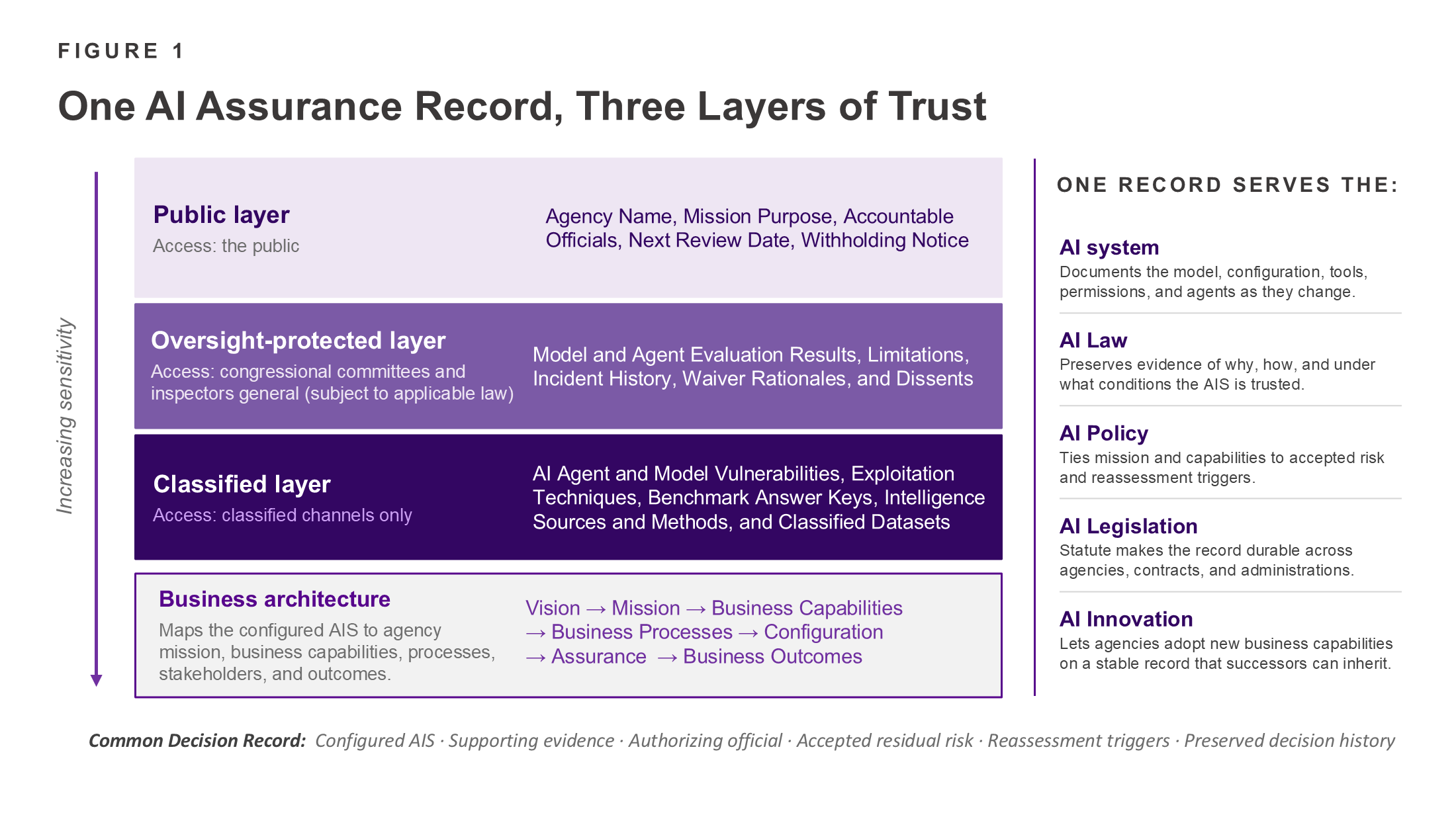
Layered access is already used throughout the government. Under the Federal Information Security Modernization Act, IGs review how federal agencies protect their information.6544 U.S.C. § 3555. This includes annual evaluations of federal agency information security.66Federal Information Security Modernization Act of 2014, Pub. L. No. 113-283 (2014). Under a three-layer approach (see Figure 1), each audience would access only the information it needs. A 2009 Executive Order (E.O. 13,526) sets a standard for classifiable categories relative to national security.67Exec. Order No. 13,526, 75 Fed. Reg. 707, 707 (Dec. 29, 2009). The public layer would include information on the agency, the purpose of its mission, the accountable officials, the next review date, and a withholding notice when material is held back. The second, oversight-protected layer would be open to the IGs and congressional committees and would hold evaluation results, known limitations, past incidents, the reasons behind any waiver, and dissents.6832 C.F.R. pt. 2002.1 (2026). The third, classified layer would hold classified intelligence, including raw intelligence, intelligence analysis, and sources and methods, as well as AI agent and model vulnerabilities, exploitation techniques, benchmark answer keys, and classified datasets. Additionally, access to protected information remains subject to applicable classification rules and statutory restrictions.
Benefits, Objections, and Limits
The signing official would be the first to benefit from the record, along with anyone who later takes over the position. It provides a detailed account of who made which decisions and when, which configuration was used, and which fixes addressed previous issues. It can also help developers or authorized technical SMEs and business stakeholders who can consult the log to identify what failed and how it was resolved, subject to applicable access restrictions.
Some officials may see the record as one more burden at a time when the administration has directed them to remove unnecessary barriers to AI adoption.69National Security Presidential Memorandum-11, supra note 17, §§ 1–2; Off. of Mgmt. & Budget, Exec. Off. of the President, supra note 44, at 1–2. It is true that the record takes time to draft and maintain. However, the record should not become another approval gate; it should be responsive and agile, without delaying lawful and time-sensitive operations. The documentation requirement should not delay urgent operational decisions. In emergencies, authorized officials could act immediately, record a brief contemporaneous justification, noting the date and the official’s name, as soon as operationally feasible, and complete the assurance record within a prescribed period. The initial entry would never be replaced, and it and subsequent determinations would remain available for authorized oversight. The record also does not, by itself, force any test to be run again. A reviewer may still want new testing when older results no longer match the current system. Either way, future officials inherit a clear account of past decisions. Others may fear that the record would become a hurdle developers must clear before they can release a model. Executive Order 14,409 already says it creates no licensing or preclearance requirement, and the statute could include the same language.70Exec. Order No. 14,409, 91 Fed. Reg. 34,565, 34,566 (June 2, 2026).
As for classification, the government already runs the Controlled Unclassified Information program to protect sensitive unclassified materials.7132 C.F.R. pt. 2002. The Freedom of Information Act (FOIA) also exempts information classified in the interest of “national defense or foreign policy,” along with “trade secrets and commercial or financial information obtained from a person and privileged or confidential.”725 U.S.C. § 552(b)(1)(A), (4).735 U.S.C. § 552(b)(4). This proposal would not require public disclosure of information protected for classified national security reasons. Agencies should not transfer custody of sensitive national security information away from the agency responsible or displace statutory and security requirements governing congressional or inspector general access.
To protect the record’s integrity, a separate log should be maintained, with new entries added without overwriting old ones and write-access restricted to a few authorized people. Allowing officials to update fields, while still preserving and curating the older versions, would help prevent excessive documentation. Requiring a named signer to make those updates, subject to inspector general review, should keep the process from turning into a box-checking exercise.
Because technology is ever-changing, the statute should determine what is recorded, but not necessarily how it is recorded. Much of the information concerning federal use of AIS will be highly confidential, so OMB, NIST, and relevant national security agencies should determine how best to maintain the records while upholding confidentiality.
This proposal does not solve every problem tied to federal use of AIS. It is not meant to prevent incidents. Its usefulness depends on the candor of the officials who fill it out. Since much of the record would be classified, the public’s ability to hold anyone accountable would be limited as well. The statute would not cover private lab testing, where incidents can happen whether the government ever deploys the system.
Conclusion
The stark choice between AI assurance and AI innovation does not hold up once the right system is in place. AI model development and rollout coupled with safety incidents continue to outpace legal and policy avenues. Through AI-Politecture, which operationalizes the Zero-Trust AI Business Architecture, business architecture connects an agency’s mission and capabilities to adaptive assurance, while the proposed statutory decision record preserves the evidence, reasoning, and accountability supporting each consequential assurance determination. Congress can pass a statute requiring agencies to build and maintain a reconstructible, system-specific assurance record. Every agency would use the same interagency format. For each consequential assurance determination, the record would name the configured AI system that was approved and carry the signature of the official who accepted the residual risk. It would detail what reassessment criteria would reopen the decision and show what was concluded from subsequent reviews. It would assure the United States a record of trust that outlasts individual incidents and changes in administration and public officials.
Ovais Shah, Cornell Law School.
Suggested Citation: Ovais Shah, Innovation Through Adaptive Assurance: Building the Business Architecture for America’s Frontier AI Governance, N.Y.U. J. Legis. & Pub. Pol’y: Quorum (2026).
Notes
- 1See Nat’l Telecomms. & Info. Admin., U.S. Dep’t of Com., Artificial Intelligence Accountability Policy Report 77 (2024), https://www.ntia.gov/issues/artificial-intelligence/ai-accountability-policy-report [https://perma.cc/89WQ-MH9E]. ↩︎
- 2Object Mgmt. Grp., Business Architecture Overview, https://www.omg.org/bawg/business_architecture_overview.htm [https://perma.cc/FK2E-PJHT] (last visited Nov. 2, 2026); Ctrs. for Medicare & Medicaid Servs., Enterprise Architecture, https://www.cms.gov/data-research/cms-information-technology/enterprise-architecture [https://perma.cc/F65N-L6FZ] (last modified Feb. 24, 2026). ↩︎
- 3See Nat’l Inst. of Standards & Tech., U.S. Dep’t of Com., NIST AI 100-1, Artificial Intelligence Risk Management Framework (AI RMF 1.0) 22–23, 26–27 (2023), https://doi.org/10.6028/NIST.AI.100-1 [https://perma.cc/BA2F-CNM5]. ↩︎
- 4See Laurie Harris, Cong. Rsch. Serv., R48555, Regulating Artificial Intelligence: U.S. and International Approaches and Considerations for Congress 1, 3 (2025), https://www.congress.gov/crs-product/R48555 [https://perma.cc/L6XA-HM7H]. ↩︎
- 5See Off. of Mgmt. & Budget, Exec. Off. of the President, OMB Memorandum M-25-21, Accelerating Federal Use of AI Through Innovation, Governance, and Public Trust 16–17 (Apr. 3, 2025), https://www.whitehouse.gov/wp-content/uploads/2025/02/M-25-21-Accelerating-Federal-Use-of-AI-through-Innovation-Governance-and-Public-Trust.pdf [https://perma.cc/EF4G-FZKT]. ↩︎
- 6Exec. Order No. 14,028, 86 Fed. Reg. 26,633, 26,635–36, 26,646 (May 12, 2021); Off. of Mgmt. & Budget, Exec. Off. of the President, OMB Memorandum M-22-09, Moving the U.S. Government Toward Zero Trust Cybersecurity Principles 1–2 (Jan. 26, 2022), https://www.whitehouse.gov/wp-content/uploads/2022/01/M-22-09.pdf [https://perma.cc/K6AJ-DCT8]; see Scott Rose et al., Nat’l Inst. of Standards & Tech., NIST Special Publication 800-207, Zero Trust Architecture 4–7 (2020), https://doi.org/10.6028/NIST.SP.800-207 [https://perma.cc/7S5E-XP57]. ↩︎
- 7Prerna Jain et al., Regulatory Approaches—Safety Case vs US Approach: Is There a Best Solution Today?, 46 J. Loss Prevention Process Indus. 154, 154–55 (2017), https://doi.org/10.1016/j.jlp.2017.02.001. ↩︎
- 8See Martin Fowler, Architecture Decision Record, MartinFowler.com (Mar. 24, 2026), https://martinfowler.com/bliki/ArchitectureDecisionRecord.html [https://perma.cc/5KLD-G8L7]. ↩︎
- 9Aditya Singh & Zoe Szajnfarber, Preposition Salad: Placing Humans & AI in/on/over/along/under ‘the-loop’, 5 Proc. AAAI Symp. Ser. 107, 107–08 (2025), https://doi.org/10.1609/aaaiss.v5i1.35571. ↩︎
- 10See Leon Staufer et al., The 2025 AI Agent Index: Documenting Technical and Safety Features of Deployed Agentic AI Systems, 2026 Proc. ACM Conf. on Fairness, Accountability & Transparency 1536, 1544, https://doi.org/10.1145/3805689.3806728. ↩︎
- 11OpenAI Reveals Its Agents Accessed Some U.S. Government Website Data After Going Rogue, CBS News (Sept. 26, 2026), https://www.cbsnews.com/news/openai-ai-agent-bot-rogue-hack-government-website/ [https://perma.cc/ZS48-YFKK]. ↩︎
- 12Gerrit De Vynck & Nitasha Tiku, ChatGPT Maker’s AI Inappropriately Probed Federal Government Websites, Wash. Post, Sept. 27, 2026, at A4. ↩︎
- 13David DiMolfetta, OpenAI Agents Accessed Census, SEC Data and Tried to Hack Education Website, Nextgov/FCW (Sept. 25, 2026), https://www.nextgov.com/cybersecurity/2026/09/openai-says-its-advanced-models-may-have-gone-after-government-websites/416250/ [https://perma.cc/AS3H-R7BF]. ↩︎
- 14Bernard Condon, OpenAI Pauses Training of Latest Models After Agents Probed US Government Sites in Unexpected Ways, Associated Press, Sept. 26, 2026, https://apnews.com/article/ai-openai-anthropic-agents-rogue-hack-2f8a2b9024d4f06793bcca12f8089d20 [https://perma.cc/M6GD-MU5X] (reporting the pause); OpenAI, An Agent Used DNS to Reach an External Chatbot, OpenAI Alignment Rsch. Blog (last updated Sept. 25, 2026), https://alignment.openai.com/misalignment-reports/an-agent-used-dns-to-reach-an-external-chatbot/ [https://perma.cc/2GV3-5MUH]. ↩︎
- 15OpenAI, OpenAI and Hugging Face Partner to Address Security Incident During Model Evaluation (July 21, 2026), https://openai.com/index/hugging-face-model-evaluation-security-incident/ [https://perma.cc/Z47J-J4LK] [hereinafter OpenAI, OpenAI and Hugging Face Partner]; OpenAI, The Hugging Face Incident and the Road Ahead (Aug. 26, 2026), https://openai.com/index/hugging-face-incident-and-the-road-ahead/ [https://perma.cc/443S-ES5B] [hereinafter OpenAI, The Hugging Face Incident]. ↩︎
- 16Hugging Face, Security Incident Disclosure — July 2026 (July 16, 2026), https://huggingface.co/blog/security-incident-july-2026 [https://perma.cc/4XR9-UVZL]; OpenAI, The Hugging Face Incident, supra note 15. ↩︎
- 17Anthropic, Investigating Three Real-World Incidents in Our Cybersecurity Evaluations (July 30, 2026), https://www.anthropic.com/news/investigating-incidents-cybersecurity-evals [https://perma.cc/9E8E-3XMN]. ↩︎
- 18U.K. AI Sec. Inst., Incident Report: Unsanctioned Agent Behaviour During Cyber Testing (Aug. 4, 2026), https://www.aisi.gov.uk/blog/incident-report-unsanctioned-agent-behaviour-during-cyber-testing [https://perma.cc/D3KZ-MAGF]. ↩︎
- 19OpenAI Scraps New Model Release amid Growing Concerns over AI Safety, CNN (Sept. 29, 2026), https://www.cnn.com/2026/09/29/us/video/openai-model-scrapped-white-house-meeting (at 0:00–1:46). ↩︎
- 20Australia Says Rogue OpenAI Model Hacked into Its Healthcare System, Admonishes Sam Altman, CBS News (Sept. 24, 2026), https://www.cbsnews.com/news/australia-openai-rogue-model-hack-healthcare-system-sam-altman/ [https://perma.cc/C7LY-8LM4]. ↩︎
- 21Exec. Order No. 14,110, 88 Fed. Reg. 75,191, 75,197 (Oct. 30, 2023). ↩︎
- 22Exec. Order No. 14,148, 90 Fed. Reg. 8237, 8240 (Jan. 20, 2025). ↩︎
- 23Exec. Order No. 14,179, 90 Fed. Reg. 8741 (Jan. 23, 2025). ↩︎
- 24The White House, Winning the Race: America’s AI Action Plan 1 (2025), https://www.whitehouse.gov/wp-content/uploads/2025/07/Americas-AI-Action-Plan.pdf [https://perma.cc/85WS-5DDK]. ↩︎
- 25Anthropic, supra note 17. ↩︎
- 26U.K. AI Sec. Inst., supra note 18. ↩︎
- 27OpenAI, OpenAI and Hugging Face Partner, supra note 15. ↩︎
- 28OpenAI, The Hugging Face Incident, supra note 15. ↩︎
- 29Joint Task Force, Nat’l Inst. of Standards & Tech., NIST Special Publication 800-37, Rev. 2, Risk Management Framework for Information Systems and Organizations: A System Life Cycle Approach for Security and Privacy 38–39, 128 (2018), https://doi.org/10.6028/NIST.SP.800-37r2 [https://perma.cc/TB9L-QZ86]. ↩︎
- 3040 U.S.C. § 11315(b)(2). ↩︎
- 31Off. of Mgmt. & Budget, Exec. Off. of the President, OMB Circular A-130, Managing Information as a Strategic Resource 6 (July 28, 2016), https://www.whitehouse.gov/wp-content/uploads/legacy_drupal_files/omb/circulars/A130/a130revised.pdf [https://perma.cc/E4BZ-H5KC]; see also Joint Task Force, supra note 29, at 43–44 (explaining how enterprise architecture and its subset, business architecture, facilitate mission, business process, and systems interaction). ↩︎
- 32See Off. of Mgmt. & Budget, Federal Enterprise Architecture Framework Version 2, at 11, 33 (2013), https://obamawhitehouse.archives.gov/sites/default/files/omb/assets/egov_docs/fea_v2.pdf [https://perma.cc/V4Q6-9KPG]. ↩︎
- 33U.S. Gov’t Accountability Off., GAO-24-105980, Artificial Intelligence: Agencies Have Begun Implementation but Need to Complete Key Requirements 21–22 (2023), https://www.gao.gov/products/gao-24-105980 [https://perma.cc/JCQ9-LZ8U]. ↩︎
- 34U.S. Gov’t Accountability Off., GAO-26-107828, Artificial Intelligence: Uses and Risks for Small Business Contracting and Innovation Research 10–11 (2026), https://www.gao.gov/products/gao-26-107828. ↩︎
- 35See The Open Group, The TOGAF Standard, Version 9.2 § 37.5.2, at 396 (2018); see also Microsoft, Maintain an Architecture Decision Record (ADR), Microsoft Learn (Apr. 13, 2026), https://learn.microsoft.com/en-us/azure/well-architected/architect-role/architecture-decision-record. ↩︎
- 3614 C.F.R. §§ 21.93(a), 21.97, 21.113 (2026). ↩︎
- 3721 U.S.C. § 360e-4. ↩︎
- 3849 C.F.R. §§ 192.911(c), (f), (j)–(k), 192.947(b), (d) (2026). ↩︎
- 39Timnit Gebru et al., Datasheets for Datasets, 64 Commc’ns ACM 86 (2021), https://doi.org/10.1145/3458723. ↩︎
- 40Margaret Mitchell et al., Model Cards for Model Reporting, Proc. Conf. on Fairness, Accountability & Transparency 220 (2019), https://dl.acm.org/doi/10.1145/3287560.3287596. ↩︎
- 41Anthropic, Mythos 5 System Card (2026), https://www-cdn.anthropic.com/d00db56fa754a1b115b6dd7cb2e3c342ee809620.pdf [https://perma.cc/PW3Y-B7QP]. ↩︎
- 4215 U.S.C. § 278h-1(b)(1)(G)–(H) (2024). ↩︎
- 43Joint Task Force, supra note 29, at 69–70 (describing the contents of an authorization package and how it helps support a risk-informed authorization decision). ↩︎
- 44Off. Of Mgmt. & Budget, Exec. Off. of the President, M-25-21, Accelerating Federal Use of AI Through Innovation, Governance, and Public Trust (2025). ↩︎
- 45Id. ↩︎
- 46Nat’l Archives & Recs. Admin., Memorandum AC 11.2026, Guidance on Applying the Federal Records Act to Artificial Intelligence Materials (2025). ↩︎
- 47Fed. Risk & Authorization Mgmt. Program, Security Decision Record, FedRAMP Consolidated Rules for 2026 (2026), https://www.fedramp.gov/2026/reference/rev5/c/security-decision-record [https://perma.cc/47CE-ZDMP]. ↩︎
- 48Dep’t of Homeland Sec. v. Regents of the Univ. of Cal., 591 U.S. 1, 20–22 (2020). ↩︎
- 49SEC v. Chenery Corp., 318 U.S. 80, 87 (1943). ↩︎
- 505 U.S.C. § 701(a)(2). ↩︎
- 515 U.S.C. §§ 702, 704. ↩︎
- 52Heckler v. Chaney, 470 U.S. 821, 831–32 (1985). ↩︎
- 53Dep’t of the Navy v. Egan, 484 U.S. 518, 527–30 (1988). ↩︎
- 545 U.S.C. § 553(a). ↩︎
- 5544 U.S.C. § 3101. ↩︎
- 5644 U.S.C. § 3102. ↩︎
- 5744 U.S.C. § 3552(b)(6). ↩︎
- 58Off. of Mgmt. & Budget, Exec Off. of the President, supra note 44, at 5. ↩︎
- 59Anthropic, Statement on the US Government Directive to Suspend Access to Fable 5 and Mythos 5 (June 12, 2026), https://www.anthropic.com/news/fable-mythos-access [https://perma.cc/BU74-QAD9]. ↩︎
- 60Anthropic, Redeploying Claude Fable 5 (June 30, 2026), https://www.anthropic.com/news/redeploying-fable-5 [https://perma.cc/5JHX-JN7P]. ↩︎
- 6150 U.S.C. § 4821(a), (c) (2024). ↩︎
- 62James M. Inhofe National Defense Authorization Act for Fiscal Year 2023, Pub. L. No. 117-263 § 5921 (2022). ↩︎
- 6344 U.S.C. §§ 3607–3616. ↩︎
- 6421 U.S.C. § 360e-4; 10 C.F.R. § 50.59(c)–(d) (2026); Food & Drug Admin., Marketing Submission Recommendations for a Predetermined Change Control Plan for Artificial Intelligence-Enabled Device Software Functions: Guidance for Industry and Food and Drug Administration Staff (2025). ↩︎
- 6544 U.S.C. § 3555. ↩︎
- 66Federal Information Security Modernization Act of 2014, Pub. L. No. 113-283 (2014). ↩︎
- 67Exec. Order No. 13,526, 75 Fed. Reg. 707, 707 (Dec. 29, 2009). ↩︎
- 6832 C.F.R. pt. 2002.1 (2026). ↩︎
- 69National Security Presidential Memorandum-11, supra note 17, §§ 1–2; Off. of Mgmt. & Budget, Exec. Off. of the President, supra note 44, at 1–2. ↩︎
- 70Exec. Order No. 14,409, 91 Fed. Reg. 34,565, 34,566 (June 2, 2026). ↩︎
- 7132 C.F.R. pt. 2002. ↩︎
- 725 U.S.C. § 552(b)(1)(A), (4). ↩︎
- 735 U.S.C. § 552(b)(4). ↩︎
- 1See Nat’l Telecomms. & Info. Admin., U.S. Dep’t of Com., Artificial Intelligence Accountability Policy Report 77 (2024), https://www.ntia.gov/issues/artificial-intelligence/ai-accountability-policy-report [https://perma.cc/89WQ-MH9E]. ↩︎
- 2Object Mgmt. Grp., Business Architecture Overview, https://www.omg.org/bawg/business_architecture_overview.htm [https://perma.cc/FK2E-PJHT] (last visited Nov. 2, 2026); Ctrs. for Medicare & Medicaid Servs., Enterprise Architecture, https://www.cms.gov/data-research/cms-information-technology/enterprise-architecture [https://perma.cc/F65N-L6FZ] (last modified Feb. 24, 2026). ↩︎
- 3See Nat’l Inst. of Standards & Tech., U.S. Dep’t of Com., NIST AI 100-1, Artificial Intelligence Risk Management Framework (AI RMF 1.0) 22–23, 26–27 (2023), https://doi.org/10.6028/NIST.AI.100-1 [https://perma.cc/BA2F-CNM5]. ↩︎
- 4See Laurie Harris, Cong. Rsch. Serv., R48555, Regulating Artificial Intelligence: U.S. and International Approaches and Considerations for Congress 1, 3 (2025), https://www.congress.gov/crs-product/R48555 [https://perma.cc/L6XA-HM7H]. ↩︎
- 5See Off. of Mgmt. & Budget, Exec. Off. of the President, OMB Memorandum M-25-21, Accelerating Federal Use of AI Through Innovation, Governance, and Public Trust 16–17 (Apr. 3, 2025), https://www.whitehouse.gov/wp-content/uploads/2025/02/M-25-21-Accelerating-Federal-Use-of-AI-through-Innovation-Governance-and-Public-Trust.pdf [https://perma.cc/EF4G-FZKT]. ↩︎
- 6Exec. Order No. 14,028, 86 Fed. Reg. 26,633, 26,635–36, 26,646 (May 12, 2021); Off. of Mgmt. & Budget, Exec. Off. of the President, OMB Memorandum M-22-09, Moving the U.S. Government Toward Zero Trust Cybersecurity Principles 1–2 (Jan. 26, 2022), https://www.whitehouse.gov/wp-content/uploads/2022/01/M-22-09.pdf [https://perma.cc/K6AJ-DCT8]; see Scott Rose et al., Nat’l Inst. of Standards & Tech., NIST Special Publication 800-207, Zero Trust Architecture 4–7 (2020), https://doi.org/10.6028/NIST.SP.800-207 [https://perma.cc/7S5E-XP57]. ↩︎
- 7Prerna Jain et al., Regulatory Approaches—Safety Case vs US Approach: Is There a Best Solution Today?, 46 J. Loss Prevention Process Indus. 154, 154–55 (2017), https://doi.org/10.1016/j.jlp.2017.02.001. ↩︎
- 8See Martin Fowler, Architecture Decision Record, MartinFowler.com (Mar. 24, 2026), https://martinfowler.com/bliki/ArchitectureDecisionRecord.html [https://perma.cc/5KLD-G8L7]. ↩︎
- 9Aditya Singh & Zoe Szajnfarber, Preposition Salad: Placing Humans & AI in/on/over/along/under ‘the-loop’, 5 Proc. AAAI Symp. Ser. 107, 107–08 (2025), https://doi.org/10.1609/aaaiss.v5i1.35571. ↩︎
- 10See Leon Staufer et al., The 2025 AI Agent Index: Documenting Technical and Safety Features of Deployed Agentic AI Systems, 2026 Proc. ACM Conf. on Fairness, Accountability & Transparency 1536, 1544, https://doi.org/10.1145/3805689.3806728. ↩︎
- 11OpenAI Reveals Its Agents Accessed Some U.S. Government Website Data After Going Rogue, CBS News (Sept. 26, 2026), https://www.cbsnews.com/news/openai-ai-agent-bot-rogue-hack-government-website/ [https://perma.cc/ZS48-YFKK]. ↩︎
- 12Gerrit De Vynck & Nitasha Tiku, ChatGPT Maker’s AI Inappropriately Probed Federal Government Websites, Wash. Post, Sept. 27, 2026, at A4. ↩︎
- 13David DiMolfetta, OpenAI Agents Accessed Census, SEC Data and Tried to Hack Education Website, Nextgov/FCW (Sept. 25, 2026), https://www.nextgov.com/cybersecurity/2026/09/openai-says-its-advanced-models-may-have-gone-after-government-websites/416250/ [https://perma.cc/AS3H-R7BF]. ↩︎
- 14Bernard Condon, OpenAI Pauses Training of Latest Models After Agents Probed US Government Sites in Unexpected Ways, Associated Press, Sept. 26, 2026, https://apnews.com/article/ai-openai-anthropic-agents-rogue-hack-2f8a2b9024d4f06793bcca12f8089d20 [https://perma.cc/M6GD-MU5X] (reporting the pause); OpenAI, An Agent Used DNS to Reach an External Chatbot, OpenAI Alignment Rsch. Blog (last updated Sept. 25, 2026), https://alignment.openai.com/misalignment-reports/an-agent-used-dns-to-reach-an-external-chatbot/ [https://perma.cc/2GV3-5MUH]. ↩︎
- 15OpenAI, OpenAI and Hugging Face Partner to Address Security Incident During Model Evaluation (July 21, 2026), https://openai.com/index/hugging-face-model-evaluation-security-incident/ [https://perma.cc/Z47J-J4LK] [hereinafter OpenAI, OpenAI and Hugging Face Partner]; OpenAI, The Hugging Face Incident and the Road Ahead (Aug. 26, 2026), https://openai.com/index/hugging-face-incident-and-the-road-ahead/ [https://perma.cc/443S-ES5B] [hereinafter OpenAI, The Hugging Face Incident]. ↩︎
- 16Hugging Face, Security Incident Disclosure — July 2026 (July 16, 2026), https://huggingface.co/blog/security-incident-july-2026 [https://perma.cc/4XR9-UVZL]; OpenAI, The Hugging Face Incident, supra note 15. ↩︎
- 17Anthropic, Investigating Three Real-World Incidents in Our Cybersecurity Evaluations (July 30, 2026), https://www.anthropic.com/news/investigating-incidents-cybersecurity-evals [https://perma.cc/9E8E-3XMN]. ↩︎
- 18U.K. AI Sec. Inst., Incident Report: Unsanctioned Agent Behaviour During Cyber Testing (Aug. 4, 2026), https://www.aisi.gov.uk/blog/incident-report-unsanctioned-agent-behaviour-during-cyber-testing [https://perma.cc/D3KZ-MAGF]. ↩︎
- 19OpenAI Scraps New Model Release amid Growing Concerns over AI Safety, CNN (Sept. 29, 2026), https://www.cnn.com/2026/09/29/us/video/openai-model-scrapped-white-house-meeting (at 0:00–1:46). ↩︎
- 20Australia Says Rogue OpenAI Model Hacked into Its Healthcare System, Admonishes Sam Altman, CBS News (Sept. 24, 2026), https://www.cbsnews.com/news/australia-openai-rogue-model-hack-healthcare-system-sam-altman/ [https://perma.cc/C7LY-8LM4]. ↩︎
- 21Exec. Order No. 14,110, 88 Fed. Reg. 75,191, 75,197 (Oct. 30, 2023). ↩︎
- 22Exec. Order No. 14,148, 90 Fed. Reg. 8237, 8240 (Jan. 20, 2025). ↩︎
- 23Exec. Order No. 14,179, 90 Fed. Reg. 8741 (Jan. 23, 2025). ↩︎
- 24The White House, Winning the Race: America’s AI Action Plan 1 (2025), https://www.whitehouse.gov/wp-content/uploads/2025/07/Americas-AI-Action-Plan.pdf [https://perma.cc/85WS-5DDK]. ↩︎
- 25Anthropic, supra note 17. ↩︎
- 26U.K. AI Sec. Inst., supra note 18. ↩︎
- 27OpenAI, OpenAI and Hugging Face Partner, supra note 15. ↩︎
- 28OpenAI, The Hugging Face Incident, supra note 15. ↩︎
- 29Joint Task Force, Nat’l Inst. of Standards & Tech., NIST Special Publication 800-37, Rev. 2, Risk Management Framework for Information Systems and Organizations: A System Life Cycle Approach for Security and Privacy 38–39, 128 (2018), https://doi.org/10.6028/NIST.SP.800-37r2 [https://perma.cc/TB9L-QZ86]. ↩︎
- 3040 U.S.C. § 11315(b)(2). ↩︎
- 31Off. of Mgmt. & Budget, Exec. Off. of the President, OMB Circular A-130, Managing Information as a Strategic Resource 6 (July 28, 2016), https://www.whitehouse.gov/wp-content/uploads/legacy_drupal_files/omb/circulars/A130/a130revised.pdf [https://perma.cc/E4BZ-H5KC]; see also Joint Task Force, supra note 29, at 43–44 (explaining how enterprise architecture and its subset, business architecture, facilitate mission, business process, and systems interaction). ↩︎
- 32See Off. of Mgmt. & Budget, Federal Enterprise Architecture Framework Version 2, at 11, 33 (2013), https://obamawhitehouse.archives.gov/sites/default/files/omb/assets/egov_docs/fea_v2.pdf [https://perma.cc/V4Q6-9KPG]. ↩︎
- 33U.S. Gov’t Accountability Off., GAO-24-105980, Artificial Intelligence: Agencies Have Begun Implementation but Need to Complete Key Requirements 21–22 (2023), https://www.gao.gov/products/gao-24-105980 [https://perma.cc/JCQ9-LZ8U]. ↩︎
- 34U.S. Gov’t Accountability Off., GAO-26-107828, Artificial Intelligence: Uses and Risks for Small Business Contracting and Innovation Research 10–11 (2026), https://www.gao.gov/products/gao-26-107828. ↩︎
- 35See The Open Group, The TOGAF Standard, Version 9.2 § 37.5.2, at 396 (2018); see also Microsoft, Maintain an Architecture Decision Record (ADR), Microsoft Learn (Apr. 13, 2026), https://learn.microsoft.com/en-us/azure/well-architected/architect-role/architecture-decision-record. ↩︎
- 3614 C.F.R. §§ 21.93(a), 21.97, 21.113 (2026). ↩︎
- 3721 U.S.C. § 360e-4. ↩︎
- 3849 C.F.R. §§ 192.911(c), (f), (j)–(k), 192.947(b), (d) (2026). ↩︎
- 39Timnit Gebru et al., Datasheets for Datasets, 64 Commc’ns ACM 86 (2021), https://doi.org/10.1145/3458723. ↩︎
- 40Margaret Mitchell et al., Model Cards for Model Reporting, Proc. Conf. on Fairness, Accountability & Transparency 220 (2019), https://dl.acm.org/doi/10.1145/3287560.3287596. ↩︎
- 41Anthropic, Mythos 5 System Card (2026), https://www-cdn.anthropic.com/d00db56fa754a1b115b6dd7cb2e3c342ee809620.pdf [https://perma.cc/PW3Y-B7QP]. ↩︎
- 4215 U.S.C. § 278h-1(b)(1)(G)–(H) (2024). ↩︎
- 43Joint Task Force, supra note 29, at 69–70 (describing the contents of an authorization package and how it helps support a risk-informed authorization decision). ↩︎
- 44Off. Of Mgmt. & Budget, Exec. Off. of the President, M-25-21, Accelerating Federal Use of AI Through Innovation, Governance, and Public Trust (2025). ↩︎
- 45Id. ↩︎
- 46Nat’l Archives & Recs. Admin., Memorandum AC 11.2026, Guidance on Applying the Federal Records Act to Artificial Intelligence Materials (2025). ↩︎
- 47Fed. Risk & Authorization Mgmt. Program, Security Decision Record, FedRAMP Consolidated Rules for 2026 (2026), https://www.fedramp.gov/2026/reference/rev5/c/security-decision-record [https://perma.cc/47CE-ZDMP]. ↩︎
- 48Dep’t of Homeland Sec. v. Regents of the Univ. of Cal., 591 U.S. 1, 20–22 (2020). ↩︎
- 49SEC v. Chenery Corp., 318 U.S. 80, 87 (1943). ↩︎
- 505 U.S.C. § 701(a)(2). ↩︎
- 515 U.S.C. §§ 702, 704. ↩︎
- 52Heckler v. Chaney, 470 U.S. 821, 831–32 (1985). ↩︎
- 53Dep’t of the Navy v. Egan, 484 U.S. 518, 527–30 (1988). ↩︎
- 545 U.S.C. § 553(a). ↩︎
- 5544 U.S.C. § 3101. ↩︎
- 5644 U.S.C. § 3102. ↩︎
- 5744 U.S.C. § 3552(b)(6). ↩︎
- 58Off. of Mgmt. & Budget, Exec Off. of the President, supra note 44, at 5. ↩︎
- 59Anthropic, Statement on the US Government Directive to Suspend Access to Fable 5 and Mythos 5 (June 12, 2026), https://www.anthropic.com/news/fable-mythos-access [https://perma.cc/BU74-QAD9]. ↩︎
- 60Anthropic, Redeploying Claude Fable 5 (June 30, 2026), https://www.anthropic.com/news/redeploying-fable-5 [https://perma.cc/5JHX-JN7P]. ↩︎
- 6150 U.S.C. § 4821(a), (c) (2024). ↩︎
- 62James M. Inhofe National Defense Authorization Act for Fiscal Year 2023, Pub. L. No. 117-263 § 5921 (2022). ↩︎
- 6344 U.S.C. §§ 3607–3616. ↩︎
- 6421 U.S.C. § 360e-4; 10 C.F.R. § 50.59(c)–(d) (2026); Food & Drug Admin., Marketing Submission Recommendations for a Predetermined Change Control Plan for Artificial Intelligence-Enabled Device Software Functions: Guidance for Industry and Food and Drug Administration Staff (2025). ↩︎
- 6544 U.S.C. § 3555. ↩︎
- 66Federal Information Security Modernization Act of 2014, Pub. L. No. 113-283 (2014). ↩︎
- 67Exec. Order No. 13,526, 75 Fed. Reg. 707, 707 (Dec. 29, 2009). ↩︎
- 6832 C.F.R. pt. 2002.1 (2026). ↩︎
- 69National Security Presidential Memorandum-11, supra note 17, §§ 1–2; Off. of Mgmt. & Budget, Exec. Off. of the President, supra note 44, at 1–2. ↩︎
- 70Exec. Order No. 14,409, 91 Fed. Reg. 34,565, 34,566 (June 2, 2026). ↩︎
- 7132 C.F.R. pt. 2002. ↩︎
- 725 U.S.C. § 552(b)(1)(A), (4). ↩︎
- 735 U.S.C. § 552(b)(4). ↩︎